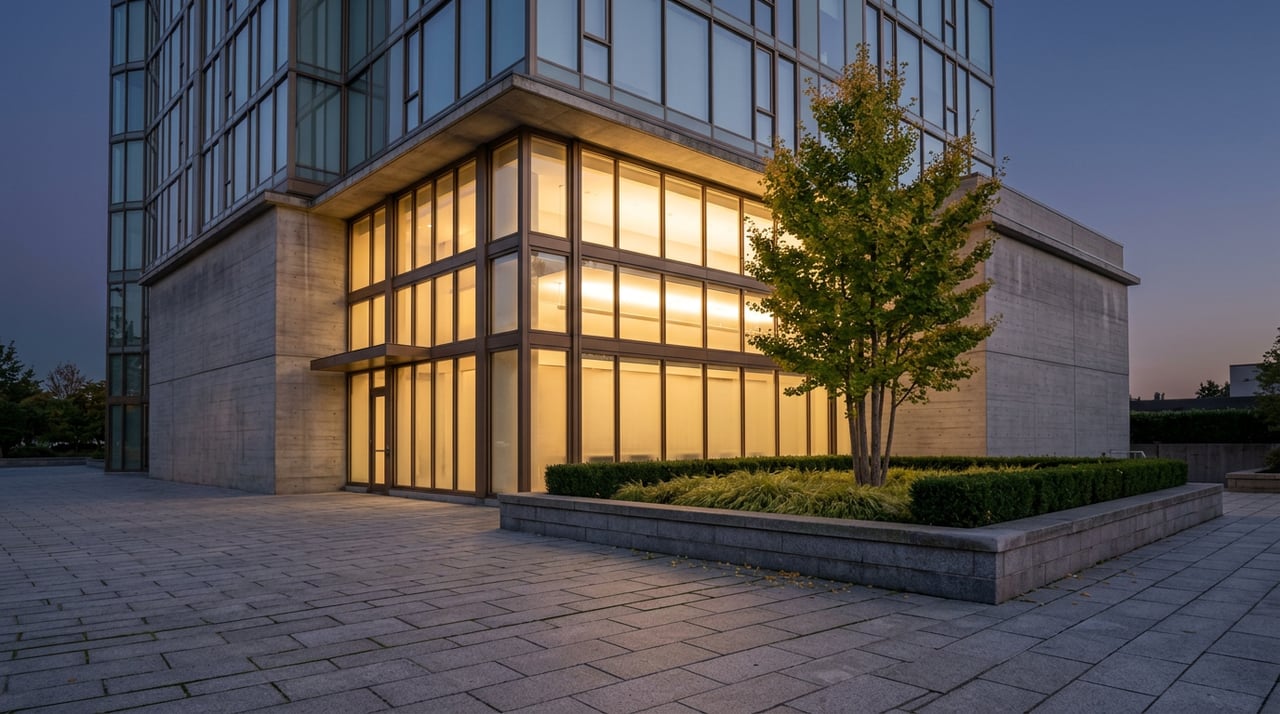
On a Thursday evening in September, the plaza in front of 300 Ashland Place clears of the last badge-wearing office workers by around six. Then something else moves in: a folding table with a speaker on it, a dance instructor calling out steps, someone who dragged a chair over from the library steps to watch. The towers around MetroTech and City Point clock out at five. The plazas underneath them do not.
The Skyline Is Advertising the Wrong Season
Downtown Brooklyn photographs like a business district, and for good reason. MetroTech houses JP Morgan and Con Edison offices. The Brooklyn Tower rises over the whole area in glass. City Point stacks a Target and a lululemon over DeKalb Market Hall. That version of the neighborhood is accurate. It's also the wrong lens for understanding what a Thursday night here looks like this fall.
The Downtown Brooklyn Partnership, the nonprofit that manages the roughly one million square feet of public plaza space spread across Albee Square, MetroTech Commons, Willoughby Plaza, and The Plaza at 300 Ashland, has built a fall calendar that runs almost entirely after the towers empty out, and almost entirely for free. This isn't seasonal decoration hung on top of a commercial district. It functions more like a second identity for the neighborhood, one that operates on its own schedule underneath the office one.
What's Actually on the Calendar
Pull the full list of what the Partnership has programmed for fall and a pattern shows up fast:
- A live DJ set from Public Service at The Plaza at 300 Ashland
- A free outdoor jazz concert from the Trevor Robertson Quartet, presented with the Brooklyn Public Library to celebrate the release of the album Bright Colors
- Salsa Hustle, an evening dance series led by instructors Jeff Selby and Ximena Salgado, with DJ Henry Maldonado running the music
- Vinyl Nights, a DJ series built entirely around vinyl-only sets spanning disco, funk, soul, house, boogie, and 80s and 90s hip hop
- A lunchtime dance series rotating through different choreographers and traditions
- A running Team DBP lunchtime ping pong series
- Return of the Buffalo: Tatanka Owe Akupi, a two-day procession of 50 life-size buffalo puppets moving through Downtown Brooklyn and into Lower Manhattan, with live music, poetry, and ceremony built into the route
- PRELUDE, a large-scale outdoor theater piece from En Garde Arts, the company marking forty years of turning city streets into performance sites, directed by Anne Bogart with text by playwright Charles L. Mee, staged at 300 Ashland Plaza
- The NYC Marathon Mile 8 cheering station at The Plaza at 300 Ashland, Sunday, November 1, with music, treats, and the Partnership's branded cowbells for anyone who wants to make noise for the runners
- The neighborhood's holiday tree lighting at Albee Square, Tuesday, November 24, with live performances building to the countdown
None of this requires a ticket. And none of it is scheduled around when the office towers are staffed. It's scheduled around when residents are actually outside.
The Marathon and the Buffalo Are the Same Idea
It's worth sitting with why a Partnership better known for managing a business improvement district would spend its fall budget on a buffalo puppet procession and a four-decade-old experimental theater company. The marathon cheering station on November 1 and the Return of the Buffalo procession are doing the same job from different directions. Both treat Downtown Brooklyn's streets and plazas as the actual stage, not the backdrop to something happening elsewhere in the borough. A cheering station at Mile 8 only works if people already live close enough to walk over with a cowbell. A puppet herd only lands if a neighborhood's public space can absorb foot traffic without it feeling like an event bolted onto a commuter corridor. Both bets assume a resident base that's already there, not one being courted.
Underneath the Towers, the Kitchens Are Turning Over
The same resident-first logic shows up in what's opening and closing at street level this season. A goop kitchen location, the brand's fourth in New York City, is set to open in Downtown Brooklyn on September 21, with a VIP preview offering free lunch and dinner pickup and delivery on September 16 and 17. Yuan Is Here, a Taiwanese street food chain that started in Hong Kong before expanding across China, picked Downtown Brooklyn for its second New York City location after Flushing, serving sub-$20 dishes like popcorn chicken, beef noodle soup, and lou rou fan. A few blocks toward the DUMBO border, Bond St Coffee and Didi's Pizza and Wine Bar were both slated to fill out a new eight-story building at 203 Jay Street by early 2026, adding a coffee counter and a casual wine-and-pizza spot to a stretch that didn't have either.
Set against those arrivals, Starbucks has been closing several Brooklyn cafes as part of a national restructuring, with locations in Downtown Brooklyn, Boerum Hill, Fort Greene, Brooklyn Heights, and East Williamsburg among those shutting down. The chain most associated with grabbing coffee between meetings is the one pulling back, while the newer arrivals (a wellness-food fast-casual brand, a regional street food concept, an independent coffee shop and wine bar) are the kind of places built for someone stopping in on a Tuesday night, not someone rushing between a 9 a.m. and a noon call.
City Point's DeKalb Market Hall remains the neighborhood's anchor for this kind of casual, resident-facing food, and locals already treat it that way. One recent visitor summed up the mall's split personality bluntly: "Skip the chain stuff upstairs and head straight to DeKalb Market Hall in the basement for the real food." The retail podium above still reads corporate. What's happening underneath and around it doesn't.
What This Means If You Already Live Here
If you already have a lease or a mortgage in Downtown Brooklyn, the practical takeaway is simple: put November 1 and November 24 on the calendar now, since both draw crowds and both are free. Vinyl Nights and the Salsa Hustle series are worth checking for current dates and locations before heading out, since Partnership programming shifts week to week across the four plazas. And if goop kitchen or Yuan Is Here are new to you, they're both worth a look before the fall openings settle into the neighborhood's regular rotation and lose their opening-week energy.
The bigger point is less about any single event or opening and more about what the pattern reveals. Downtown Brooklyn's public image, driven by its skyline and its office tenants, undersells what the neighborhood has become at street level after five o'clock. The Partnership isn't running a token fall festival to soften a commercial district's edges. It's running programming dense enough, and specific enough (a puppet procession, a forty-year theater company, a marathon cheering station with its own branded cowbells) that it only makes sense as an investment in the people who live here, not the people who commute here.
That's a useful thing to know if you're already deciding how to spend a Thursday night this fall. It's also a useful thing to know if you're thinking about what Downtown Brooklyn will look like five years from now, since a neighborhood investing this much in resident-facing public life at street level tends to keep building on it.
If you're weighing a move to Downtown Brooklyn, or already own here and are wondering how the neighborhood's identity is shifting underneath its skyline, the Luxury Alliance Team spends its time exactly on street-level signals like these. Schedule a consultation to talk through what it means for your next move.